Diverse Rural Lab (DRL) is a business and community model that propose a scenario for a diversified resilient future in the US Corn Belt. The DRL model suggests an alternative model for food production and processing while maintaining a high quality of life in the rural areas. It deals with five aspects needed to push rural areas into prosperity: work, make, live, play, and research.
To facilitate a transition towards more resilient future, the project suggests two sets of networks on two levels. On the lower level, the project proposes gathering small communities to create a cell that include different sets of interactions. Together, different cells form an upper-level network of interactions. On the upper level, the project creates resilient agricultural economy where different cells provide different high-quality products to the regional and the global markets.
Cells in the DRL model are run by different AgriBusiness and Community (ABC) companies. Each cell includes three components: rural lab communities, rural lab production areas, and rural lab hubs. The rural lab communities in the cell rise from the existing rural communities, and expand around them. ABC companies will support the existing communities by intentionally adding growers (and growers’ families) to the existing population. It will also create a connection between the different rural lab communities within the cell through bringing these communities to the rural lab hubs.
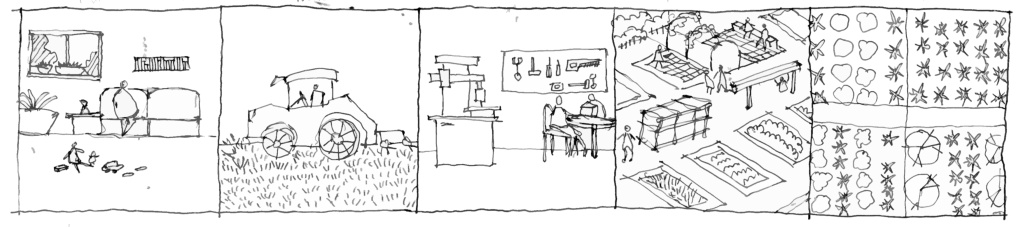
The five elements in the DRL model. From Left to right: live, work, make, play, and research.
The rural lab communities live in small-scale built-up areas that include housing, a school, a small library, a common pleasure garden (to provide local food and entertainment for everyone), a water harvesting system, public outdoor spaces, and a main street that includes small market for local food and produce, a café, a restaurant, a small sport center, and a few other small businesses. Each of these communities is surrounded by a green belt. The greenbelt provides ecosystem services and other services for people and the environment.
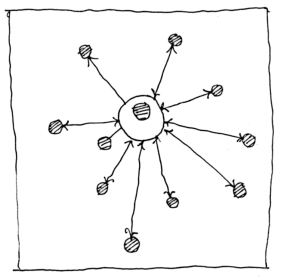
Hub connected to communities.
Rural lab communities work in the surrounding rural lab production areas. The rural lab production areas include sites for agricultural production (including food, feed, livestock, and energy production) as well as agricultural processing sectors. Each production site is an experimental field that collects data and send it to the ABC company. This means that each field inform knowledge production and overall prosperity of the Diverse Rural Lab.
Rural lab hubs are the nucleus of this DRL model, and the most complex part of it. Each of the rural cells is centered around a hub located less than 50 miles from rural lab community in the cell. The hub does not necessarily include housing for the rural community. It is actually more of an infrastructure unit that facilitates different processes in the other two cell components. The hub can be completely a separate unit located in a central area between the rural lab communities, or can be attached to a community in the middle of the cell.
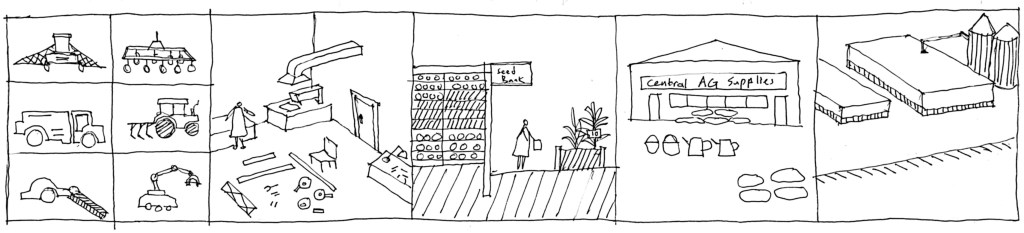
Hub components to support production. From left to right: centralized equipment, workshop, seed bank, agricultural supplies, and centralized storage.
To ensure the functionality of the cell, each hub includes components to support production, and components to support community. Each component addresses one or more aspect central to the Diverse Rural Lab: work, make, live, play, and research. To support production, each hub includes a centralized machines, tools, equipment, and experts to run and maintain these tools. Tools and tool experts can move from the hub to production areas depending on the need. Since the production in this system is very diversified, the hub needs a continuous development of new tools. This is managed through a research and design workshop in the hub, where experts, universities, and the rural lab communities collaborate to create new tools.[1] Different cells can also support each other’s in this case. In addition to the tool center, each hub includes a seed bank, a center for agricultural supplies, and a central storage area for agricultural fresh and processed produce. Each of these units will also be run by specialists working with the ABC company.
Since communities are central to this model, each hub has different components to support the communities, to ensure a high quality of life for these communities, and to bring these communities together. Among these components are a healthcare center, schools, small local academy for all (supported by university extension), community gathering spaces, local retail or market center, a demonstration community farm, and recreation spaces. In addition, there are few student dorms for university students living and working in the cells as part of the extension work or as interns in the ABC companies. These students have the option to become a member of the cell after graduation. Another set of housing units in the hub aims to host tourists interested in exploring the cell. Similar to the rural lab communities, the hub is also surrounded by a green belt. And just like the production supporting components, the community supporting components are not totally fixed in the hub, but can move in a way or another to the rural lab communities in certain times of needs.
The movement of people, materials, and ideas across time and space are very important in this model. A light rail transit system will ensure a smooth movement of everyone and everything in the cell, and the existing railroad will ensure this movement between different cells. This includes the movement of tools, machines, products, experts, community members, among others.
While the DRL is a business-oriented model, its responsibility towards the community makes it prioritize accessibility to everything for everyone. Therefore, the model has an open access and open-source approach within the cell (which is run by one ABC company). The system ensures a fair access to housing, healthy food, healthcare, infrastructure, knowledge, among other aspects.
In terms of production, each community has a wide diversity of produce to support the community itself and the surrounding urban environments. A shorter list of produce in each community will be directed towards export. For example, Community A produces different small grains for export, Community B produces different berries, Community C produces diary, etc.[2] Also, each community in the cell will have a thematic crop that is very specific to this community. For example, Community A is very well known in its high-quality oats, oat products, and fine dining around oat products. This is a good way to attract tourists.

A zoom in into some processes in the rural lab production areas. From left to right: food production, feed production, livestock, energy production, food processing.
*Part of my Ph.D. research at Purdue with Dr. Aaron Thompson.
[1] Inspired by Fab Lab https://www.fablabs.io/ and Global Village Construction Set https://www.opensourceecology.org/gvcs/.
[2] In this way, these communities are a little less diversified than our hopes, but they still have a diversified aspect (a very wide diversity for community and local consumption, and a fewer species for export) . I think this model can be more practical.
 Portfolio
Leave a comment