*This text is part of my masters thesis from Birzeit University. Thank you to my advisor, Dr. Omar Tesdell. Thank you Also to Doa’ Ewais for her assistance with the field work and the interviews.
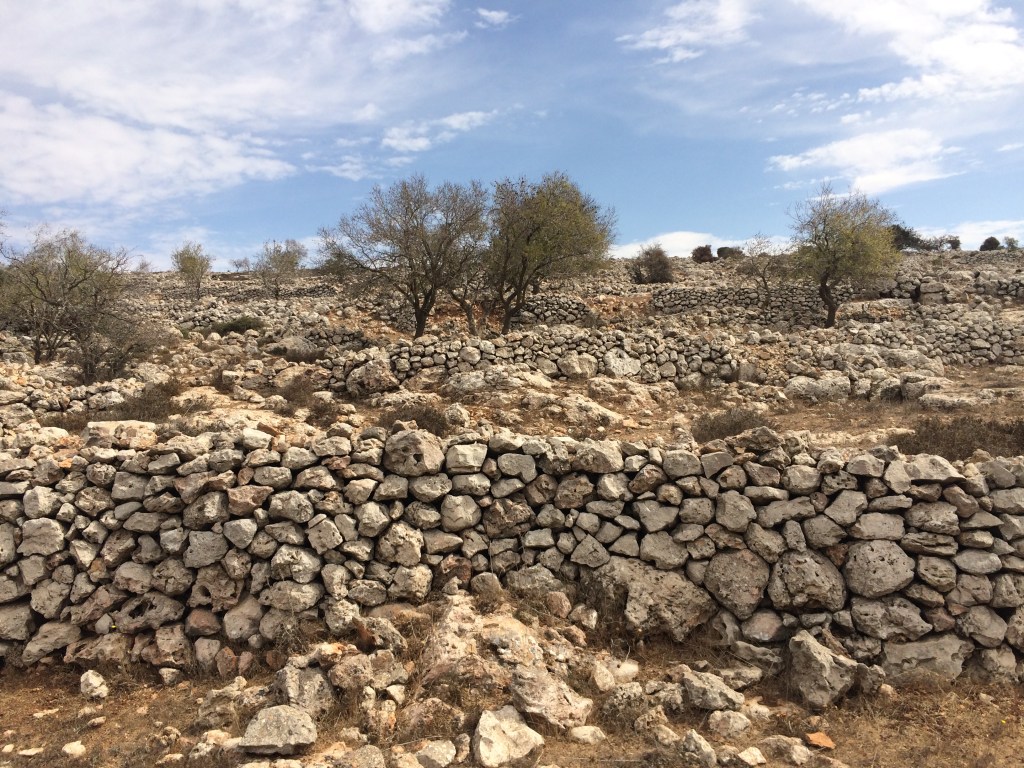
Looking at the mountain range of central Palestine, the eye will see an expanded landscape of terraces and dry-stone walls. One can argue that these elements are among the most prominent human interventions in this landscape. Humans, over thousands of years, had put enormous effort into transforming the sloping mountains of this area into flat agricultural terraces from the base of the mountains to their summits. These terraces were supported by linear stone walling known locally as sanasel (singular: sensela).[1] Up to a recent time in earth’s history, the mountains of Palestine were covered with natural vegetation that protected the soil. Yet the human’s deliberate removal of the natural vegetation and the tillage, along with natural forces – such as rain and wind – had led to a continuous erosion of the soil. This had created an urgent need to convert slopes into flat, cultivable surfaces protected from erosion.[2] [3]Agricultural terraces supported by stone walling, in fact, are not unique features to the Palestinian landscapes, but they are widespread in the whole Mediterranean area, among other regions of the world.[4]
Sanasel can be defined as a dry-stone walling that serves a structural function of supporting the soils and sediments of the agricultural terraces. Terraces (Arabic: Habala (singular), Habalat or Habayel (plural)), on the other hand, are anthropogenic agricultural techniques utilized to modify the natural landscape in favor of the agricultural practices. The main principle of terracing is to transform the shallow-soil slopes into less sloping land with enough soil for farming.[5] Terracing had allowed to exploit the Palestinian slopes after the removal of the natural forests and the subsequent intensification of the soil erosion issues – which was slightly present before the massive human intervention of the natural landscapes.[6]
In this research, sanasel and terraces are considered as major agricultural infrastructures that interact with other agricultural infrastructures, human beings, and the agroecological landscapes to enable and facilitate the agricultural practices in the mountains of Palestine. Sanasel and terraces, like other agricultural infrastructures, are entities that reproduce the different interactions in the natural landscapes and with it. This allows for an agricultural exploitation in the sloping areas in Palestine and elsewhere. The available research points out a wide variety of processes that occur in the landscape as a result of the presence of terraces and dry sone walling.[7] [8] [9] Some of them are very consistent with what was shown by the oral interviews. The local narrative in the study area often mentions four main reasons behind the creation of sanasel and terraces: to protect the soil from erosion; to increase the water content in the soil; to convert the land into arable land; and to increase the yield.[10] Mr. Farid Olwan (87 years old) explained sanasel, habalat, and the reasons behind their construction. He said:
“Sanasel are stones that block the soil from eroding. It supports the soil. We put one sensela here and another one there so the soil stays in its place… Otherwise go see a mountain, the soil gradually falls down the stream to the wadi-bed. Habala is sensela after sensela… If the land is slightly drifted, they construct habala to prevent the erosion… To make the land flat… The main reason is to plant it [the habala] and to take advantage of it… To make subsistence… It holds soil and water and makes the land saturated [with water after rain], then the crops grow well.”[11]
[1] العامري ورحال، مناطير: قصور المزارع في ريف فلسطين، 12؛ عراف، القرية العربية الفلسطينية: مبنى واستعمالات أراض، 121-123؛ رجا شحادة، “المشي في فلسطين،” في سرحة في مرتفعات رام الله، تأليف فرحات مهوي وسحر قواسمي، تحرير خالد توما، ترجمة كارول خوري، سلسلة رواق حول تاريخ العمارة (رام الله: رواق – مركز المعمار الشعبي، 2012)، 10–13؛ رائد فايق دار فرحات، مقابلة مسجلة.
[2] العامري ورحال، مناطير: قصور المزارع في ريف فلسطين؛ عراف، القرية العربية الفلسطينية: مبنى واستعمالات أراض؛ مهوي وقواسمي، سرحة في مرتفعات رام الله؛ شحادة، “المشي في فلسطين؛” مهوي وقواسمي، سرحة في مرتفعات رام الله.
[3] Shimon Gibson, “The Archaeology of Agricultural Terraces in the Mediterranean Zone of the Southern Levant and the Use of the Optically Stimulated Luminescence (OSL) Dating Method,” in Soils and Sediments as Archives of Environmental Change. Geoarchaeology and Landscape Change in the Subtropics and Tropics., ed. Bernhard Lucke, Rupert Bäumler, and Michael Schmidt (Erlangen: Fränkische Geographische Gesellschaft, 2015), 295–314; Karl W Butzer, “Accelerated Soil Erosion: A Problem of Man-Land Relationships,” in Perspectives on Environment, ed. Ian R. Manners and Marvin W. Mikesell (Washington: Association of American Geographers, 1974), 57–78.
[4] J. E. Spencer and G. A. Hale, “The Origin, Nature and Distribution of Agricultural Terracing,” Pacific Viewpoint: Change, Conflict, Continuity 2, no. 1 (1961); Jennifer Moody and AT Grove, “Terraces and Enclosure Walls in the Cretan Landscape” (Man’s Role in the Shaping of the Eastern Mediterranean Landscape: Proceedings of the Symposium on the Impact of Ancient Man on the Landscape of the E Med Region & the Near East: Groningen, March 1989, CRC Press, 1990), 183; Mauro Varotto, Luca Bonardi, and Paolo Tarolli, World Terraced Landscapes: History, Environment, Quality of Life (Springer, 2018); Jonathan A. Sandor, “Ancient Agricultural Terraces and Soils,” in Footprints in the Soil: People and Ideas in Soil History, ed. Benno Warkentin (Amsterdam: Elsevier, 2006), 505–34.
[5] pencer and Hale, “The Origin, Nature and Distribution of Agricultural Terracing”; Gibson, “The Archaeology of Agricultural Terraces in the Mediterranean Zone of the Southern Levant and the Use of the Optically Stimulated Luminescence (OSL) Dating Method”; Lewis, “Lebanon. The Mountain and Its Terraces”; Bonardi, “Terraced Vineyards in Europe.”
[6] Gibson, “The Archaeology of Agricultural Terraces in the Mediterranean Zone of the Southern Levant and the Use of the Optically Stimulated Luminescence (OSL) Dating Method,” 303–4; Butzer, “Accelerated Soil Erosion: A Problem of Man-Land Relationships.”
[7] These are beyond the scope of this research.
[8] See for example: Charles D Frederick and Athanasia Krahtopoulou, “Deconstructing Agricultural Terraces: Examining the Influence of Construction Method on Stratigraphy, Dating and Archaeological Visibility,” Landscape and Land Use in Postglacial Greece, 2000, 79–94; Sandor, “Ancient Agricultural Terraces and Soils”; Paolo Tarolli, Federico Preti, and Nunzio Romano, “Terraced Landscapes: From an Old Best Practice to a Potential Hazard for Soil Degradation Due to Land Abandonment,” Anthropocene, Landscapes in the Anthropocene, 6 (June 1, 2014): 10–25, https://doi.org/10.1016/j.ancene.2014.03.002; Spencer and Hale, “The Origin, Nature and Distribution of Agricultural Terracing”; John M Treacy and William M Denevan, “The Creation of Cultivable Land through Terracing,” in The Archaeology of Garden and Field, ed. Naomi F. Miller and Kathryn L. Gleason (Philadelphia: University of Pennsylvania Press, 1997), 91–110; Antony Brown et al., “European Agricultural Terraces and Lynchets: From Archaeological Theory to Heritage Management,” World Archaeology 52, no. 4 (2020): 566–88; Asunción Romero-Díaz, Joris de Vente, and Elvira Díaz-Pereira, “Assessment of the Ecosystem Services Provided by Agricultural Terraces,” Pirineos 174 (2019); Z. RON, “Agricultural Terraces in the Judean Mountains,” Israel Exploration Journal 16, no. 1 (a 1966): 33–49; E Roose, “Traditional Strategies for Soil and Water Conservation in Mediterranean Areas,” Rubio, Josè Luis, 2002; Raoul Manenti, “Dry Stone Walls Favour Biodiversity: A Case-Study from the Appennines,” Biodiversity and Conservation 23, no. 8 (2014): 1879–93.
[9] سامي بقلة، “الحياة النباتية والحيوانية في مرتفعات رام الله،” في سرحة في مرتفعات رام الله، تأليف فرحات مهوي وسحر قواسمي، تحرير خالد توما، ترجمة كارول خوري، سلسلة رواق حول تاريخ العمارة (رام الله: رواق – مركز المعمار الشعبي، 2012)، 16-20.
[10] فريد موسى علوان، مقابلة مسجلة 1؛ فريد موسى علوان، مقابلة مسجلة 2؛ محمد صقر عبد الغني محمد علي إبراهيم أغلب باشا، مقابلة مسجلة 1؛ محمد صقر عبد الغني محمد علي إبراهيم أغلب باشا، مقابلة مسجلة 2؛ حليمة محمد علي حماد، مقابلة مسجلة 1؛ رائد فايق دار فرحات، مقابلة مسجلة؛ حربي عياد، مقابلة مسجلة.
[11] فريد موسى علوان، مقابلة مسجلة 1؛ فريد موسى علوان، مقابلة مسجلة 2.
 Portfolio
Leave a comment