
*This text is part of my masters thesis from Birzeit University. Thank you to my advisor, Dr. Omar Tesdell. Thank you Also to Doa’ Ewais for her assistance with the field work and the interviews.
In the Palestinian traditional knowledge, the term habala (plural: habalat) is used to describe what is known in the academic writings as agricultural terraces. That is the mostly flat land supported by stone walling against soil erosion. In fact, the term is also used to describe water catchment areas linked to underground water cisterns and supported by stone walling. The later is less common in the Palestinian mountain landscapes.
1. Terraces that prevent soil erosion and convert the sloping land into flat areas: These terraces play two main critical roles. First, they manage soil erosion in the moderate to highly inclined mountains. Second, they convert the mountain slopes into successive flat steps. This kind of terraces is the most widespread model in the Palestinian mountains.[1] In fact, this type of terraces is not uniform along the landscapes. It could actually be divided into sub-models based onto different criterion. However, the study suggests a sub-classification based on the scale or the area of the terrace. Hence dividing terraces onto (i) small-scale pocket terraces that often enclose one tree; and (ii) Large-scale linear terraces that accommodate several trees, crops, or even buildings. Another sub-division could be suggested for both of these types according to the terrace plan. The pocket terraces may be (i.a) polygonal pockets confined from at least one edge (see pictures and drawings for clarification), or they may be (i.b) circular (or semicircular) pockets separated from other elements in the landscape. The last case is locally known as the sedda (i.e., dam or block). As for the linear terraces, it is possible to divide them into (ii.a) continuous linear terraces, and (ii.b) discontinuous and braided linear terraces.

Types (i) small-scale pocket terraces that often enclose one tree
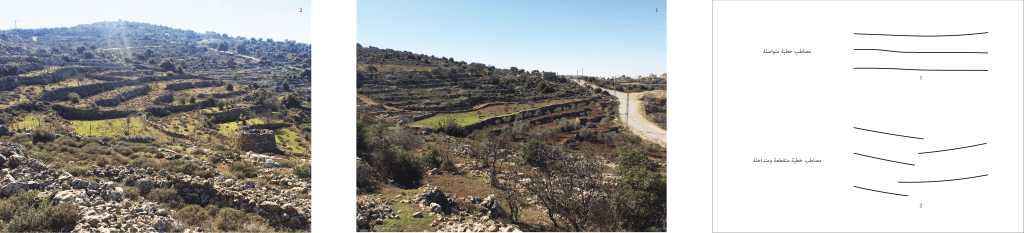
Types (ii) Large-scale linear terraces that accommodate several trees, crops, or even buildings
2. Terraces that reduce soil erosion in slightly sloping areas: Generally, these are found in the semi-flat plains within the central mountain range of Palestine. The main function of this model is to reduce soil erosion. The stone walling of this model is simple in design and of low height. Adding stone walls to this almost flat landscape is not necessary as the potential of erosion in it is low.[2]

Terraces that reduce soil erosion in slightly sloping areas
3. Terraces that prevent soil erosion and harvest rainwater: This type of terraces plays an important role in rainwater harvesting in addition to its function in blocking the soil from eroding. The study had documented two models under this type, both of which are located in valleys. The first model is associated with highly sloping valleys, or what is locally known as (she’ab, i.e., forked land). The dry-stone walling of this model is similar to the walling of the first class of terracing (terraces that prevent soil erosion and convert the sloping land into flat areas). The difference is that they run perpendicular to the contour lines of the mountains. Moreover, they are constructed using larger stones to bear the pressure of the water coming down the valley slope.[3] The second model, on the other hand, is associated with valleys of little slope. What is special about this model is the width of the dry-stone walling (sometimes more than 3 meters). These wide stone walls were actually designed to bear the pressure and the weight of the water coming down from the surrounding mountains. This model may be associated with the presence of two sets of stone walling: one running with the slope of the adjacent mountain (parallel to the mountain’s slope), and the other with the slope of the valley (perpendicular to the mountain’s slope). Moreover, a water canal is sometimes linked to this model. The canal’s object is to manage the flow of the water and limit its path in the valley to a narrow area, thus saving the remaining area of the valley for agriculture.[4]
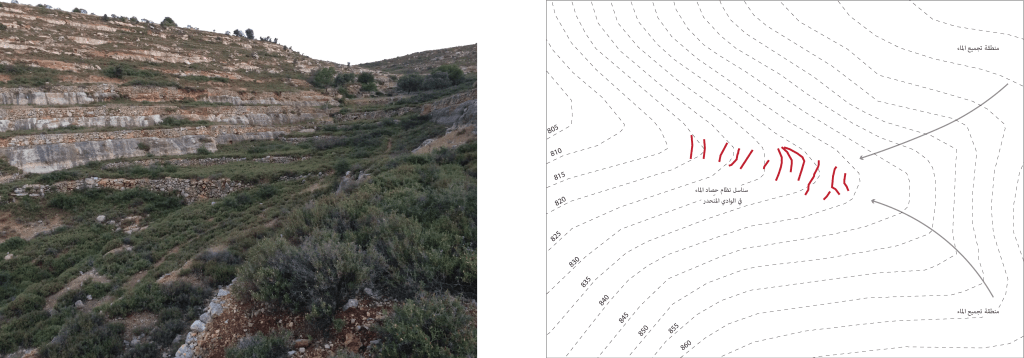

Terraces that prevent soil erosion and harvest rainwater – she’ab
[1] عراف، القرية العربية الفلسطينية: مبنى واستعمالات أراض؛ العامري ورحال، مناطير: قصور المزارع في ريف فلسطين.
[2] RON, “Agricultural Terraces in the Judean Mountains,” a 1966, 35.
[3] Sandor, “Ancient Agricultural Terraces and Soils”; Theib Oweis, D. Prinz, and A. Hachum, Water Harvesting: Indigenous Knowledge for the Future of the Drier Environments. ICARDA, Aleppo, Syria, 40 Pp (Aleppo: International Center for Agricultural Research in the Dry Areas, 2001).
[4] Oweis, Prinz, and Hachum, Water Harvesting; Gibson, “The Archaeology of Agricultural Terraces in the Mediterranean Zone of the Southern Levant and the Use of the Optically Stimulated Luminescence (OSL) Dating Method,” 299; Brian Beckers, Jonas Berking, and Brigitta Schütt, “Ancient Water Harvesting Methods in the Drylands of the Mediterranean and Western Asia,” ETopoi. Journal for Ancient Studies 2 (September 1, 2013).
 Portfolio
Leave a comment